
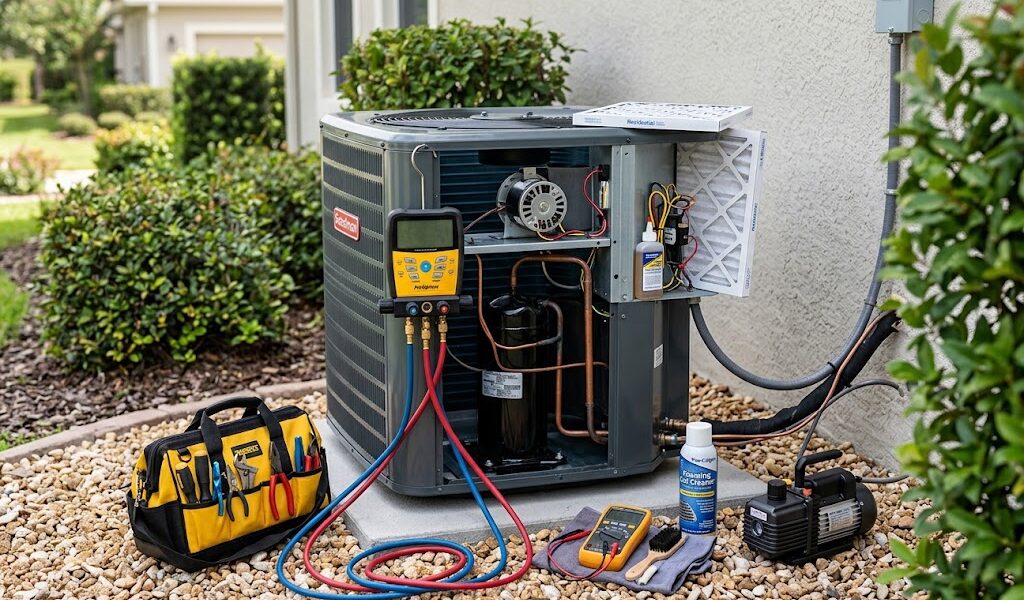
If you schedule professional AC maintenance, you should know what you are actually paying for. A proper maintenance visit is more than changing an air filter or looking at the outdoor unit. A qualified HVAC technician should inspect the system, clean important components, check electrical and refrigerant-related components, verify airflow and drainage, test system operation, and identify developing problems before they become major repairs.
For homeowners in St. Petersburg and throughout the Tampa Bay area, regular AC maintenance is especially important because air conditioning systems can face long operating periods, high humidity, and demanding summer conditions.
At Speed Air & Heating, our AC maintenance service includes inspections, tune-ups, cleanings, and performance checks tailored to the equipment being serviced. With more than 15 years serving the Tampa Bay area and a team of NATE-certified technicians (License #CAC1822334), our goal is to identify problems early, keep the system operating reliably, and help homeowners make informed decisions about repairs or replacement.
Key Takeaways
- A professional AC maintenance visit should include both inspection and performance testing.
- Technicians commonly check electrical connections, refrigerant-related components, coils, airflow, drainage, thermostat operation, and moving parts.
- Cleaning the evaporator and condenser coils can help the system transfer heat more effectively.
- Condensate drain inspections are important because clogged drainage can contribute to water damage and indoor humidity problems.
- Homeowners can handle basic tasks such as checking filters, but electrical, refrigerant, and internal mechanical work should be left to qualified professionals.
- The exact maintenance checklist can vary depending on the AC system, its condition, age, and manufacturer requirements.
- Speed Air & Heating’s technicians are NATE-certified and the company has served Tampa Bay area homeowners and businesses for more than 15 years.
What Is Included in a Professional AC Maintenance Visit?
A professional AC maintenance visit typically combines cleaning, inspection, adjustment, testing, and preventative troubleshooting.
ENERGY STAR’s maintenance checklist recommends checking thermostat settings, electrical connections, motor voltage and current, moving parts, condensate drainage, system controls, coils, refrigerant, and blower components during routine HVAC maintenance.
At Speed Air & Heating, our published AC maintenance checklist includes:
- Coolant/refrigerant level and pressure checks
- Condenser coil cleaning and inspection
- Evaporator coil and fan motor inspection
- Thermostat inspection and calibration
- Wiring, capacitors, and relay inspection
- Compressor startup inspection
- Electrical connection testing and tightening
- Condensate drain cleaning
- Moving-part lubrication
- Air-handler and outdoor-disconnect inspection
- Filter replacement when supplied by the customer
- System performance testing
- Priority scheduling and service discounts for maintenance plan customers
The exact work performed can vary by system and condition. A maintenance visit should not be treated as a one-size-fits-all checklist.

1. Thermostat Check and Calibration
The thermostat controls when your AC starts, stops, and maintains the selected temperature. A technician can check the thermostat’s operation and verify that its readings and settings are appropriate for the system.
A thermostat problem can sometimes look like an air-conditioning problem. If the thermostat is inaccurate or not communicating correctly with the equipment, the system may not cool as expected.
Professional maintenance can help distinguish a control issue from a mechanical or refrigeration problem.
2. Electrical Inspection
Air conditioners contain electrical components that need to operate safely and reliably.
A professional maintenance visit may include inspecting and tightening electrical connections and checking components such as:
- Wiring
- Capacitors
- Relays
- Disconnects
- Electrical connections
- Motor electrical readings
ENERGY STAR specifically recommends tightening electrical connections and measuring voltage and current on motors because faulty electrical connections can contribute to unsafe operation and reduce component life.
This is one reason electrical inspection should not be treated as a DIY maintenance task.
3. Condenser Coil Cleaning and Inspection
The outdoor condenser coil releases heat removed from inside the building. Dirt and debris on the coil can interfere with heat transfer and make the system work harder.
During professional maintenance, the technician can inspect the outdoor coil and clean it when necessary.
ENERGY STAR recommends cleaning both evaporator and condenser coils as part of cooling-system maintenance because dirty coils can reduce cooling performance, increase operating time, and contribute to higher energy use.
For coastal properties around St. Petersburg, keeping the outdoor portion of the system clean is particularly important because local environmental conditions can add to the equipment’s workload.
4. Evaporator Coil Inspection
The evaporator coil is located on the indoor side of a typical central AC system. It plays a major role in absorbing heat from indoor air.
A technician may inspect the evaporator coil for dirt, buildup, signs of moisture problems, and other conditions that could affect system performance.
Speed Air & Heating specifically lists evaporator coil inspection as part of its AC maintenance checklist.
If a coil is heavily contaminated, simply replacing the filter may not solve the underlying airflow or cooling problem. The technician may recommend additional cleaning or repair depending on what the inspection reveals.
5. Airflow and Blower Inspection
Good airflow is essential for an air conditioner to operate properly.
A professional maintenance visit can include inspecting the blower motor and related airflow components. Technicians may also look for restrictions that could prevent the system from moving the right amount of air.
ENERGY STAR notes that airflow problems can reduce HVAC efficiency and recommends cleaning and adjusting blower components as part of cooling-system maintenance.
Weak airflow can have several causes, including a dirty filter, blower problems, coil contamination, duct restrictions, or other system issues. Maintenance provides an opportunity to identify those problems before they become more disruptive.
6. Condensate Drain Inspection and Cleaning
Your AC removes moisture from indoor air as it cools your home. That moisture needs somewhere to go.
The condensate drain system carries water away from the indoor equipment. If the drain becomes clogged, water can back up and potentially cause property damage or contribute to indoor humidity problems.
ENERGY STAR recommends inspecting the condensate drain because a plugged drain can cause water damage and affect indoor humidity.
Speed Air & Heating also includes condensate drain cleaning in its published maintenance checklist.
This is an important part of AC maintenance that homeowners may not notice until water starts appearing where it should not.
7. Refrigerant and Cooling-System Checks
Refrigerant is part of the cooling process, so technicians may check refrigerant-related conditions during maintenance.
Speed Air & Heating’s published maintenance checklist includes checking coolant levels and pressure and states that its maintenance offering can include adding up to two pounds of refrigerant when needed.
However, refrigerant should not simply be added without investigating why the system needs it. If a system is losing refrigerant, a leak or another problem may need attention.
ENERGY STAR recommends checking refrigerant levels and adjusting them when necessary because an improper charge can reduce efficiency and shorten equipment life.
8. Compressor Startup and System Controls
The compressor is one of the most important and expensive components in a central AC system.
During maintenance, a technician can observe how the system starts and operates. Speed Air & Heating includes compressor startup inspection and system performance testing in its maintenance checklist.
Checking the startup sequence can help identify unusual electrical or operational behavior before the system experiences a complete failure.
A maintenance visit is not a guarantee that a compressor or another component will never fail. Instead, the goal is to identify observable problems and abnormal conditions early.
9. Moving Parts and Lubrication
Some HVAC equipment contains moving components that may require inspection and, where appropriate, lubrication.
ENERGY STAR includes lubrication of moving parts in its recommended maintenance checklist.
Proper maintenance helps reduce unnecessary friction and wear. The technician should follow the equipment manufacturer’s requirements because not every modern component requires the same type or amount of lubrication.
10. Air Handler and Outdoor Disconnect Inspection
A professional AC maintenance visit should look at more than the outdoor condenser.
Speed Air & Heating includes inspection of the air handler and outdoor disconnect in its published maintenance checklist.
Looking at both sides of the system gives the technician a better picture of how the complete cooling system is operating.
This matters because an air conditioner can have an outdoor component that appears to be working while an indoor airflow, drainage, electrical, or coil problem is affecting performance.
11. Filter Inspection or Replacement
The filter is one of the simplest AC maintenance items, but it is also one homeowners should monitor regularly.
ENERGY STAR recommends checking a central AC filter monthly and replacing it when it is dirty, with a minimum replacement interval of every three months as general guidance.
The correct schedule can vary depending on the filter, equipment, household conditions, pets, dust levels, and system use.
Speed Air & Heating lists filter replacement as part of its maintenance service when the filter is supplied by the customer.
12. Final Performance Test
A maintenance visit should finish with more than a visual inspection.
The technician should verify that the system operates correctly after the maintenance work. Speed Air & Heating includes a performance test in its published AC tune-up checklist.
Testing gives the technician an opportunity to confirm that the equipment starts, runs, and cools as expected and to identify conditions that may require further attention.
What Does an AC Technician Look for During Maintenance?
A professional technician is looking for more than dirt.
The inspection is intended to identify conditions that could affect:
- Cooling performance
- Airflow
- Electrical safety
- Refrigerant operation
- Moisture removal
- System reliability
- Component wear
- Energy use
- Future repair needs
This is where professional maintenance provides value beyond basic cleaning. The technician can connect individual symptoms and measurements to the way the complete system is operating.
For example, weak airflow may point toward a dirty filter, blower issue, coil contamination, or another restriction. A clogged condensate drain may not affect cooling immediately but can create a water problem. An electrical component may still be functioning while showing signs of deterioration.
The goal is to identify these conditions while there is still time to address them.
What Can Homeowners Do Between Professional AC Visits?
Homeowners can handle several basic maintenance tasks without opening the equipment or working with electrical or refrigerant components.
Check the air filter
Look at the filter regularly and replace or clean it according to the filter manufacturer’s instructions and the needs of your household.
Keep the outdoor unit clear
Remove leaves, grass, and other obvious debris from around the outdoor condenser while keeping a safe distance from the equipment.
Pay attention to changes
Watch for:
- Weak airflow
- Warm air from supply vents
- Unusual noises
- Water around the indoor equipment
- Unusual odors
- Longer-than-normal run times
- Frequent cycling
- Unexpected increases in energy use
These signs do not automatically identify a particular failure, but they are reasons to have the system evaluated.
Leave electrical and refrigerant work to professionals
Do not attempt to open electrical compartments, measure refrigerant pressure, or perform complex repairs without the appropriate training and equipment.
Routine homeowner maintenance and professional HVAC maintenance serve different purposes.
How Often Should You Schedule Professional AC Maintenance?
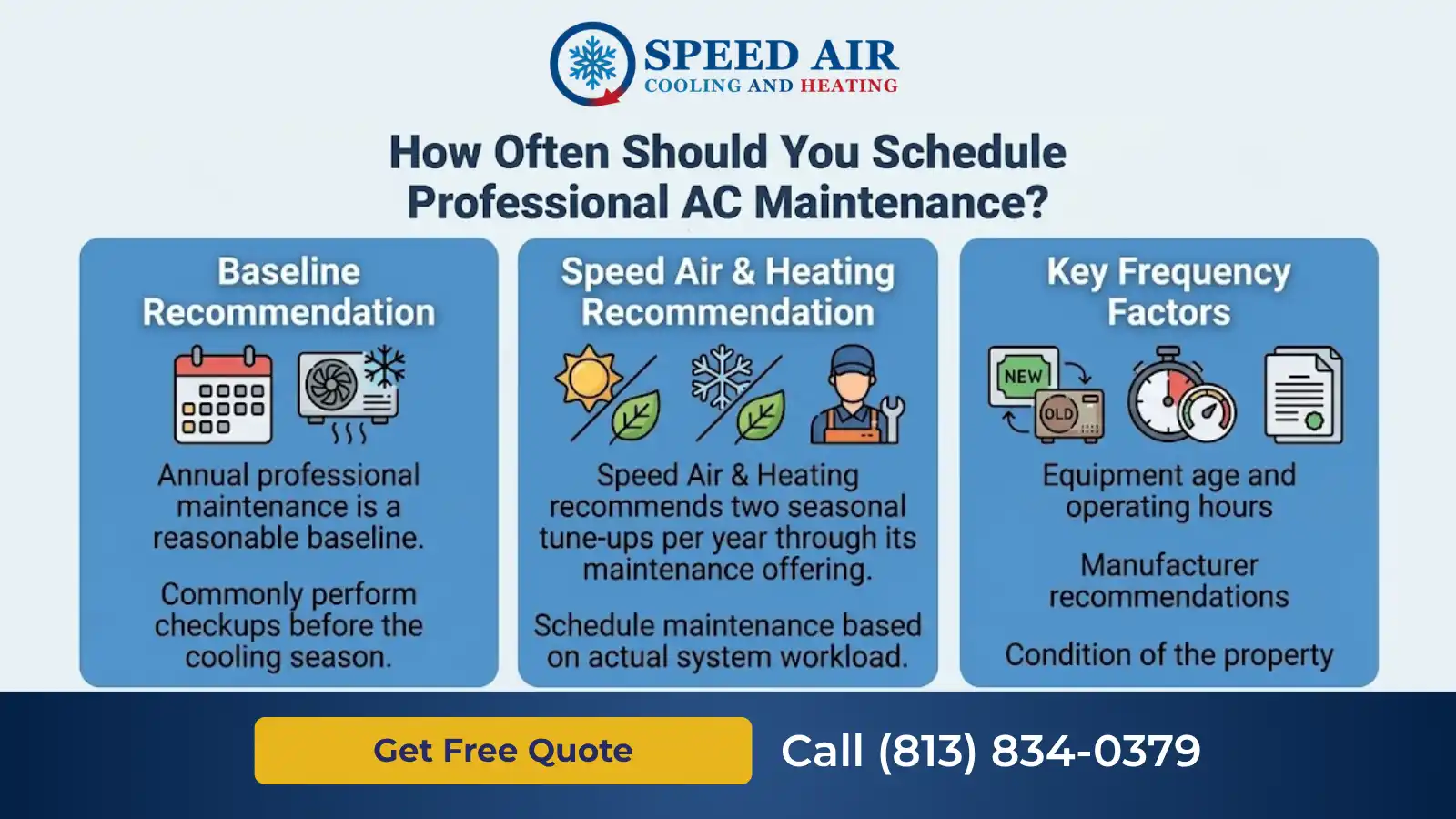
For many residential systems, annual professional maintenance is a reasonable baseline, while some homeowners choose more frequent service based on equipment condition, usage, and manufacturer recommendations.
ENERGY STAR recommends yearly HVAC tune-ups and notes that contractors commonly perform cooling-system checkups before the cooling season.
Speed Air & Heating recommends two seasonal tune-ups per year through its maintenance offering.
Florida homeowners may also choose to schedule maintenance based on actual system workload rather than waiting for a traditional heating-and-cooling season.
The right frequency depends on factors such as equipment age, operating hours, system type, previous maintenance history, and the condition of the property.
Speed Air & Heating currently offers a discounted AC tune-up special for new customers scheduling seasonal maintenance. Since promotional pricing and terms can change, homeowners should confirm current offer details when booking.
Get a Free Quote!
Call (813) 834- 0379
Why Is AC Maintenance Important in St. Petersburg, FL?
St. Petersburg homes can place significant demands on air-conditioning equipment.
Speed Air & Heating’s local maintenance guidance identifies high humidity, long cooling periods, and coastal conditions as factors that can affect HVAC equipment in the area.
That makes preventative maintenance particularly useful for identifying problems before they become an emergency.
Local conditions also make the condition of the outdoor equipment worth paying attention to. A system exposed to demanding outdoor conditions should not be maintained according to a generic checklist alone. The technician should consider the equipment’s actual condition and operating environment.
What Is the Difference Between AC Maintenance and AC Repair?
The main difference is the purpose of the visit.
AC maintenance is preventative. The technician inspects, cleans, tests, and adjusts the system to help maintain reliable operation and identify developing problems.
AC repair is corrective. The technician diagnoses an existing problem and repairs or replaces the component responsible for the failure.
For example, discovering a worn electrical component during a maintenance visit may lead to a recommended repair before the system stops working. If the homeowner waits until the system fails, the same issue may become an emergency service call.
Maintenance cannot prevent every possible failure, but it can provide an opportunity to find problems before they become more disruptive.
How Do You Know Whether an AC Maintenance Visit Was Thorough?
A good question to ask is not simply, “Did you clean my AC?”
Instead, ask what was actually inspected and tested.
A thorough maintenance visit should give you a clearer understanding of the system’s condition. Depending on your equipment, you should expect discussion of items such as:
- Electrical components
- Refrigerant-related conditions
- Coils
- Airflow
- Thermostat operation
- Condensate drainage
- Filters
- System controls
- Compressor operation
- Overall performance
A professional should also explain anything that needs attention rather than leaving you with a vague statement that the system is “fine.”
At Speed Air & Heating, our approach is built around honest communication, transparent service, and explaining available options to customers. The company serves St. Petersburg and communities throughout the Tampa Bay area and offers AC maintenance, AC repair, AC installation, and mini-split services.
When Should You Call for AC Repair Instead of Maintenance?
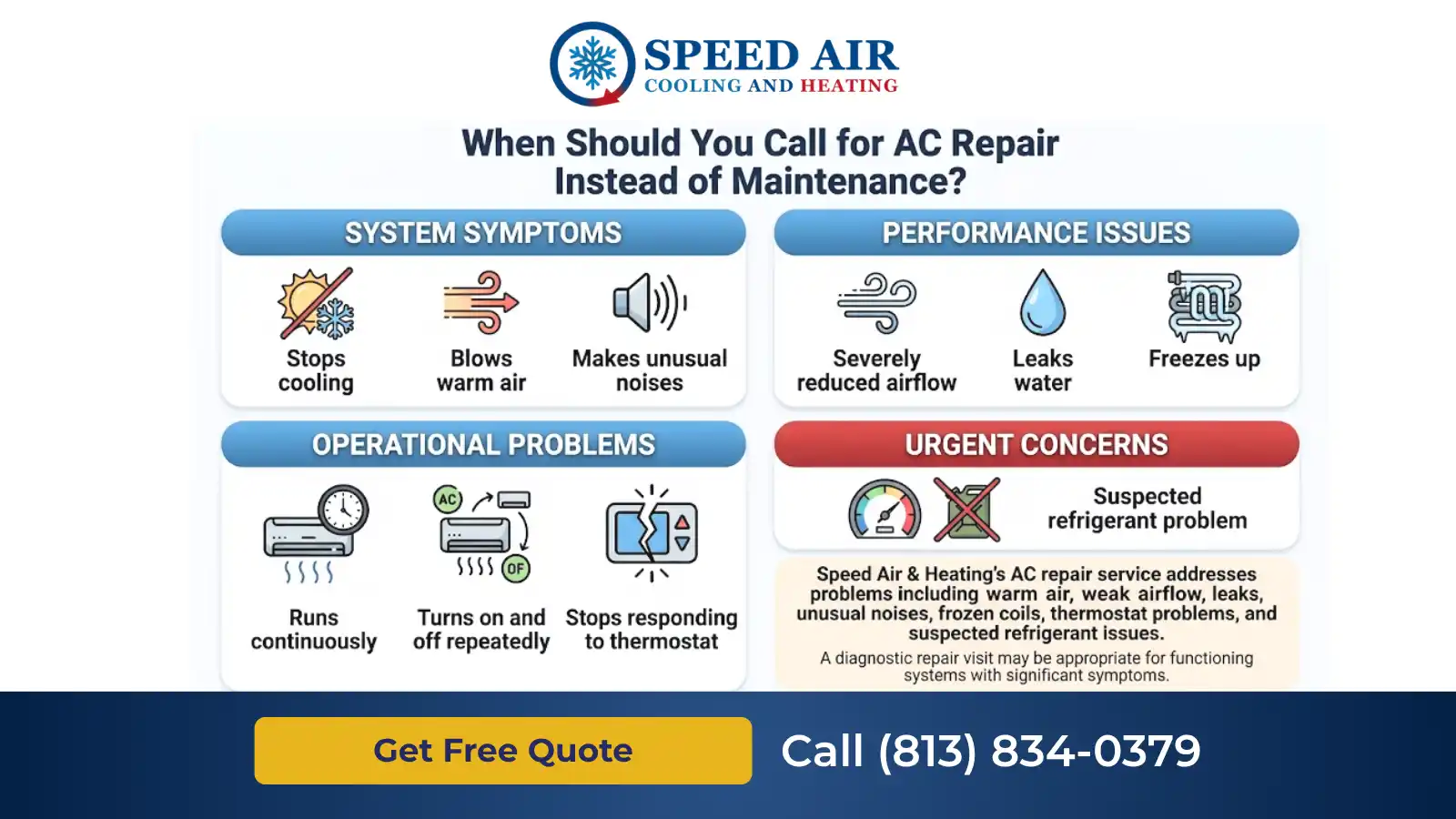
Maintenance is intended for a functioning system that needs preventative attention. If your AC is already showing significant symptoms, a diagnostic repair visit may be more appropriate.
Consider contacting an HVAC professional if your system:
- Stops cooling
- Blows warm air
- Leaks water
- Makes unusual or loud noises
- Has severely reduced airflow
- Freezes up
- Runs continuously without adequately cooling
- Turns on and off repeatedly
- Has a suspected refrigerant problem
- Stops responding to the thermostat
Speed Air & Heating’s AC repair service addresses problems including warm air, weak airflow, leaks, unusual noises, frozen coils, thermostat problems, and suspected refrigerant issues.
Get a Free Quote!
Call (813) 834- 0379
Professional AC Maintenance in St. Petersburg, FL
Your air conditioner does more than blow cold air. It relies on electrical components, coils, airflow, refrigerant, drainage, controls, and mechanical components working together.
That is why a professional AC maintenance visit should involve more than a quick visual inspection.
Speed Air & Heating (License #CAC1822334) provides AC maintenance throughout St. Petersburg and the Tampa Bay area. Our company offers professional HVAC maintenance, AC repair, AC installation, and mini-split installation and repair, with service available 24/7.
If your AC is due for maintenance or you have noticed a change in cooling performance, contact us today at (813) 834-0379 to discuss your system with Speed Air & Heating.
Frequently Asked Questions
Q: What is included in a professional AC maintenance visit?
A: A professional AC maintenance visit generally includes inspection, cleaning, testing, and adjustment of key components. Common tasks include checking the thermostat, electrical connections, coils, airflow, condensate drain, refrigerant-related conditions, blower components, and overall system operation. The exact checklist varies by equipment and condition.
Q: How long does an AC maintenance visit take?
A: The duration depends on the system, its condition, accessibility, and the amount of cleaning or troubleshooting required. A straightforward maintenance visit can be relatively quick, while a system requiring additional inspection or cleaning may take longer.
Q: Does AC maintenance include refrigerant?
A: It depends on the service agreement and the system’s condition. Speed Air & Heating’s published maintenance service includes checking refrigerant levels and pressure and may include adding up to two pounds when needed.
Q: Can I perform AC maintenance myself?
A: Homeowners can safely handle basic tasks such as checking or replacing filters and keeping the area around the outdoor unit clear. Electrical testing, refrigerant work, and internal mechanical inspections should be handled by qualified HVAC professionals.
Q: How often should I have my AC professionally maintained?
A: A yearly tune-up is a common baseline recommendation. Some systems and homeowners may benefit from service twice a year, particularly when equipment operates heavily or has a history of problems. ENERGY STAR recommends yearly HVAC tune-ups, while Speed Air & Heating offers two seasonal tune-ups through its maintenance service.
Q: Is AC maintenance worth it if my system is working normally?
A: Yes. Maintenance is intended to identify developing problems and keep the system operating properly before a small issue becomes a larger disruption. However, maintenance does not guarantee that an AC system will never require repairs or replacement.
Other Services We Offer