
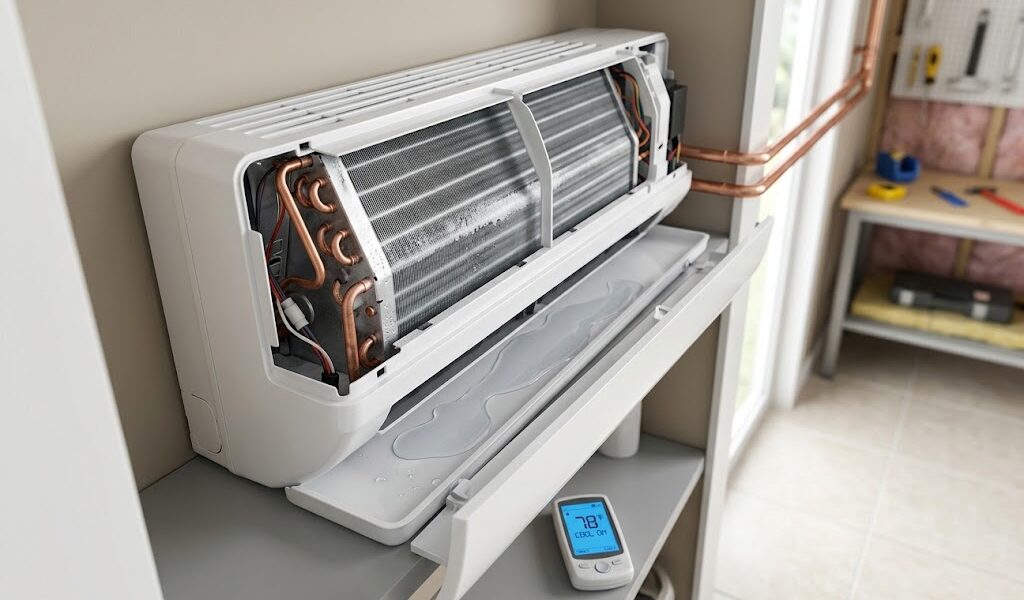
If your AC is running but your home still feels warm, Speed Air and Heating understands that the system is doing only part of its job. The indoor blower may be moving air, but something is preventing the cooling system from removing enough heat from your home.
Why is my AC running but not cooling? Common causes include a dirty air filter, incorrect thermostat settings, restricted airflow, a dirty outdoor condenser coil, frozen evaporator coils, low refrigerant, electrical problems, ductwork issues, or a failing compressor. Some problems are simple to check yourself, while others require professional AC repair.
For Florida homeowners, a cooling problem can become uncomfortable quickly, especially during periods of high outdoor temperatures. The key is to identify what you can safely check first and recognize when continued operation could make the problem worse.
Key Takeaways
- Check the thermostat, air filter, and outdoor unit before assuming the AC needs major repairs.
- A dirty filter or blocked condenser can restrict airflow and reduce cooling performance.
- Ice on the refrigerant lines or indoor coil can indicate a frozen coil, airflow problem, or refrigerant issue.
- Low refrigerant is usually a symptom of a leak or another system problem rather than something homeowners should simply “top off.”
- If the AC runs continuously without cooling, or the same problem returns after basic troubleshooting, professional diagnosis can help identify the underlying cause.
- Turning off a malfunctioning system can prevent unnecessary strain on components while you arrange service.
Why Is My AC Running but Not Cooling?
An air conditioner can run continuously while failing to cool your home when the cooling cycle is not transferring heat effectively or when airflow is restricted.
The most common possibilities include:
- The thermostat is set incorrectly.
- The air filter is dirty.
- The outdoor condenser is dirty or blocked.
- The evaporator coil is frozen.
- Refrigerant is low because of a leak or system problem.
- The compressor, fan, capacitor, or another electrical component is malfunctioning.
- Airflow is restricted by vents, ducts, or other problems.
- The AC system is incorrectly sized or no longer capable of meeting the home’s cooling demand.
Carrier similarly identifies thermostat settings, dirty filters, blocked outdoor equipment, frozen evaporator coils, refrigerant problems, damaged equipment, and undersized systems among the causes of an AC that runs without effectively cooling.
The important distinction is that an AC that is running is not necessarily an AC that is cooling properly. The indoor fan can circulate air even when the refrigeration side of the system is not operating correctly.
1. Check the Thermostat First
Before assuming something has failed inside the HVAC system, check the thermostat.
Make sure:
- The mode is set to Cool.
- The temperature is set below the current indoor temperature.
- The fan is set to Auto rather than On, unless you intentionally want continuous fan operation.
- A programmed schedule has not changed the temperature setting.
- The thermostat display is functioning normally.
When the fan is set to “On,” the blower can continue circulating air even when the compressor is not actively cooling. That can make the system appear to be running while the air coming from the vents is not consistently cold.
If adjusting the thermostat restores normal cooling, you may not have an equipment failure at all.
If the thermostat is correct and the AC continues running without cooling, move to the next checks.
2. A Dirty Air Filter Can Restrict Cooling
A clogged air filter is one of the simplest problems to check and one of the common reasons an AC can struggle to cool.
The filter catches airborne particles before they enter the HVAC system. As dirt accumulates, airflow through the system can become restricted.
You may notice:
- Weak airflow from vents
- Longer cooling cycles
- A home that does not reach the thermostat setting
- Ice forming around the evaporator coil or refrigerant lines
- Higher-than-normal energy use
Restricted airflow can interfere with heat transfer and may contribute to coil freezing.
If the filter is visibly dirty, replace it with the correct filter for your system. If changing the filter does not restore cooling, there may be another problem behind the poor performance.
Why doesn’t a new filter always fix the problem?
Because a dirty filter is only one possible cause.
If the AC still runs without cooling after the filter is replaced, the system may have a refrigerant, coil, electrical, compressor, ductwork, or airflow problem that requires further diagnosis.
3. The Outdoor AC Unit May Be Dirty or Blocked
Your outdoor condenser needs adequate airflow to release the heat removed from your home.
Leaves, grass, dirt, and other debris can accumulate around the outdoor unit or on the condenser coil. When airflow through the coil is restricted, the system may lose cooling capacity and operate less efficiently.
Look around the outdoor unit for obvious obstructions.
Keep vegetation and objects from blocking the unit’s airflow. If the condenser coil itself appears heavily dirty or damaged, professional cleaning may be appropriate.
The outdoor condenser is an important part of the heat-transfer process: it releases heat that the refrigerant has collected from inside your home. A blocked or dirty condenser can therefore contribute to an AC that runs but does not cool effectively.
4. Ice on the AC Can Mean the Coil Is Frozen
If you see ice on the refrigerant lines or around the indoor evaporator coil, don’t assume that adding more refrigerant is the answer.
A frozen evaporator coil can be associated with restricted airflow, refrigerant problems, or other system issues. Once the coil freezes, the ice itself interferes with heat transfer and airflow, making the cooling problem worse.
Signs can include:
- Ice on the copper refrigerant lines
- Ice around the indoor coil
- Weak airflow
- Warm air from the vents
- The system running for unusually long periods
If you see substantial ice, turn the cooling system off and allow it to thaw rather than continuing to run it. Persistent freezing should be professionally diagnosed because the underlying cause still needs to be identified.
5. Low Refrigerant Can Cause the AC to Run Without Cooling
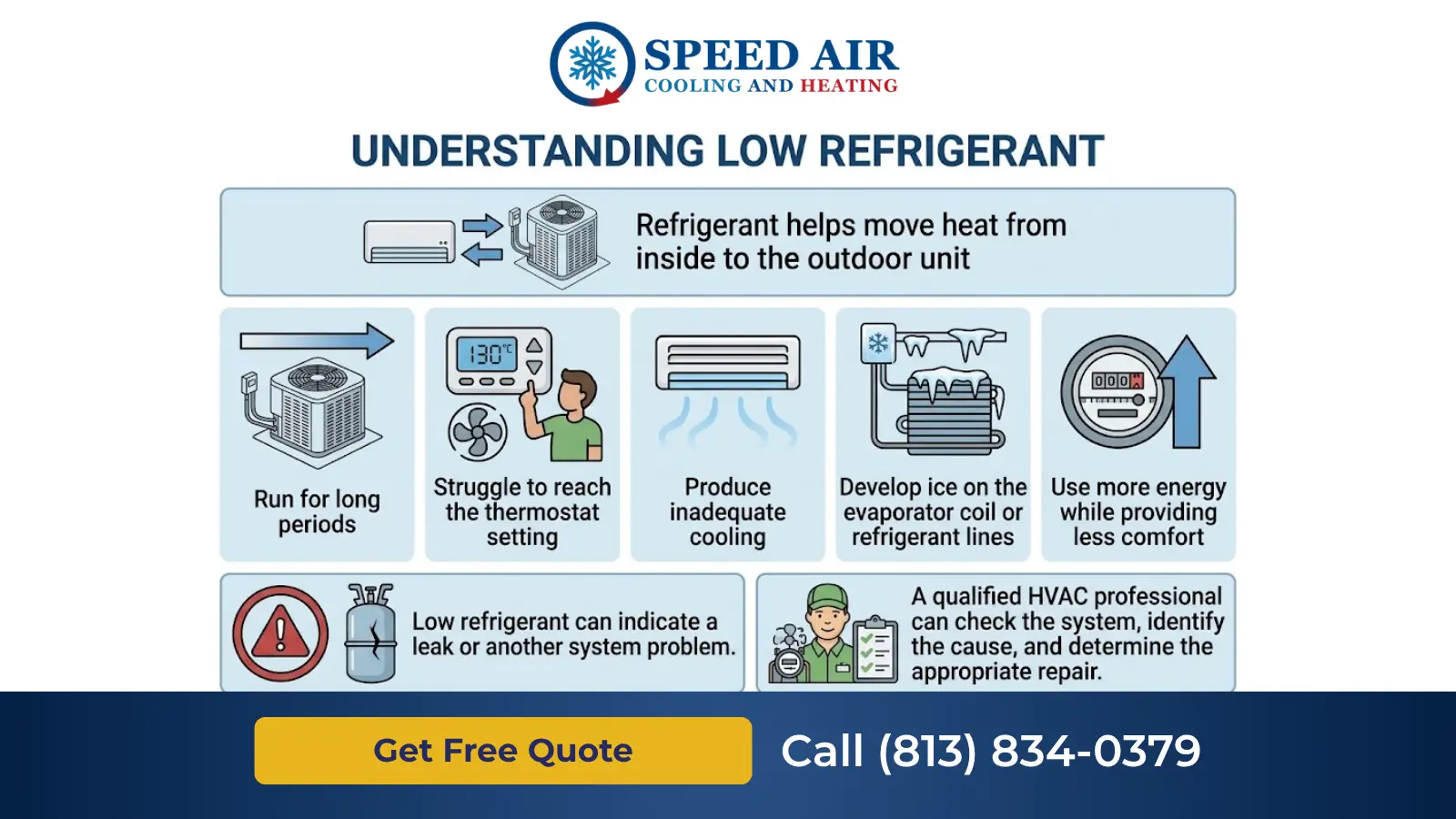
Refrigerant is essential to the cooling process. It circulates through the system and helps move heat from inside your home to the outdoor unit.
When refrigerant is low, the AC may:
- Run for long periods
- Struggle to reach the thermostat setting
- Produce inadequate cooling
- Develop ice on the evaporator coil or refrigerant lines
- Use more energy while providing less comfort
Low refrigerant can indicate a leak or another system problem. It is not simply a routine maintenance item that homeowners should attempt to correct themselves. A qualified HVAC professional can check the system, identify the cause, and determine the appropriate repair.
Does low refrigerant always mean there is a leak?
Not necessarily in every situation, but a refrigerant system is designed as a closed system. If refrigerant is repeatedly low, the cause should be investigated rather than repeatedly adding refrigerant without addressing the underlying issue.
That distinction matters because simply restoring refrigerant does not necessarily resolve the reason the system lost cooling performance.
6. The Compressor or Outdoor Fan May Have a Problem
The compressor and outdoor fan are critical components of the cooling system.
If the indoor blower is running but the outdoor equipment is not operating normally, the AC may circulate air without actually providing effective cooling.
Potential equipment problems can involve components such as:
- Compressor
- Capacitor
- Contactor
- Condenser fan motor
- Electrical controls
- Wiring
These components involve electrical systems and should not be opened or tested by a homeowner who is not qualified to work on HVAC equipment.
If the thermostat is calling for cooling but the outdoor unit is silent, repeatedly shutting off, making unusual sounds, or behaving inconsistently, professional AC troubleshooting is appropriate.
7. Your Ductwork or Vents May Be Restricting Airflow
Sometimes the AC itself is producing cool air, but that air is not reaching the rooms effectively.
Check for simple airflow problems such as:
- Closed supply vents
- Furniture blocking registers
- Obstructed return-air openings
- Damaged or disconnected accessible ductwork
- Very weak airflow from several vents
If only certain rooms are warm while others cool normally, airflow distribution deserves particular attention.
If the entire home remains warm despite strong airflow, the issue may be farther upstream in the cooling system.
8. The AC May Be Undersized or Struggling With the Cooling Load
An air conditioner can be mechanically functional and still struggle to maintain the desired indoor temperature if its capacity is not appropriate for the home.
Sizing involves more than square footage. Factors such as insulation, windows, building characteristics, ductwork, and the home’s cooling load affect the amount of cooling capacity required.
An undersized system may run for long periods during demanding weather without maintaining the desired temperature.
This is different from a sudden loss of cooling.
If your AC previously cooled the house normally and suddenly stopped, a repair issue is more likely to deserve investigation before assuming the system needs replacement.
What Should I Check if My AC Is Running but Not Cooling?
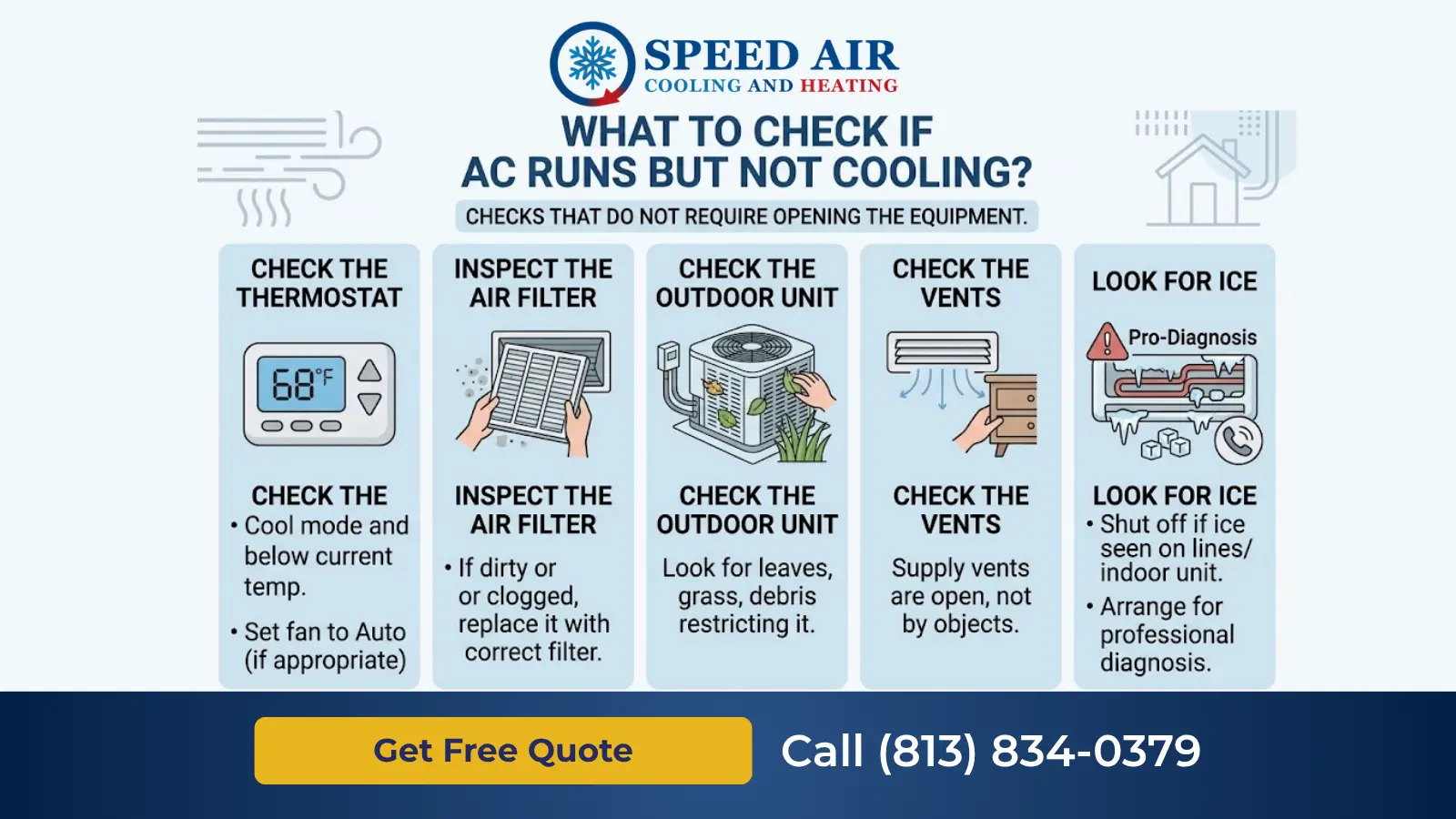
Start with the checks that do not require opening the equipment.
Step 1: Check the thermostat
Confirm that it is in Cool mode and set below the current indoor temperature. If appropriate for your system, set the fan to Auto.
Step 2: Inspect the air filter
If it is dirty or clogged, replace it with the correct filter.
Step 3: Check the outdoor unit
Look for leaves, grass, or other obvious debris restricting the outdoor unit.
Step 4: Check the vents
Make sure supply vents are open and not blocked by furniture or other objects.
Step 5: Look for ice
If you see ice on the refrigerant lines or around the indoor unit, shut the cooling system off and arrange for professional diagnosis.
Step 6: Pay attention to the symptoms
Notice whether:
- The outdoor unit is running.
- Airflow is weak or strong.
- The air feels warm or simply isn’t cold enough.
- The system runs continuously.
- Ice appears.
- The thermostat reaches the set temperature.
- The problem affects the entire house or only certain rooms.
These details can help an HVAC technician narrow down the cause.
Get a Free Quote!
Call (813) 834- 0379
When Should You Call for AC Repair?
You should consider professional AC repair when basic checks do not restore cooling or when you notice signs of a mechanical or refrigerant problem.
Professional service is especially appropriate if:
- The AC runs continuously without reaching the set temperature.
- The system repeatedly freezes.
- You suspect a refrigerant leak.
- The outdoor unit is not operating correctly.
- A circuit breaker repeatedly trips.
- You hear unusual electrical or mechanical noises.
- Airflow remains weak after replacing the filter.
- The system has stopped cooling despite apparently normal thermostat settings.
Continuing to operate a malfunctioning AC can place additional strain on the system, particularly when the underlying problem involves airflow, refrigerant, or major components.
Should I Turn Off My AC if It Is Running but Not Cooling?
If the AC is clearly malfunctioning and not providing cooling, turning it off can be a sensible temporary step while you arrange service.
This is particularly important when you see ice, notice unusual noises, smell something abnormal, or suspect an electrical problem.
There is little benefit in continuously running an AC that is unable to cool the home. The system may continue consuming energy while the underlying fault remains unresolved.
If your home is becoming dangerously hot, especially for infants, older adults, pets, or anyone sensitive to heat, address the indoor temperature promptly rather than waiting indefinitely for the system to recover.
Why Florida Heat Can Make an AC Problem More Noticeable
Florida homes place substantial demands on air-conditioning systems because cooling is not just about lowering temperature. The system also plays an important role in managing indoor humidity.
When an AC is operating properly, it removes heat and moisture from indoor air. When cooling performance declines, the home can begin to feel uncomfortable even before the thermostat reading changes dramatically.
That is why a system that is “still running” should not automatically be considered functional.
For homeowners in and around St. Petersburg, a sudden loss of cooling can be particularly disruptive. A system that runs for hours without reaching the desired temperature deserves attention rather than simply being left to run continuously.
AC Repair vs. AC Replacement: How Do You Know Which You Need?
Not every AC problem means you need a new system.
A repair may make sense when the underlying problem is a serviceable component, airflow restriction, maintenance issue, or other repairable fault.
Replacement becomes a more relevant question when the system is older, has recurring failures, requires significant repairs, or can no longer provide reliable cooling.
The right decision depends on the condition of the equipment, the nature of the failure, expected repair requirements, efficiency, and the home’s cooling needs.
A professional evaluation can help separate a repair problem from a system that has reached the point where replacement should be considered.
How Regular AC Maintenance Can Help
Routine AC maintenance does not guarantee that a system will never fail, but it can help identify developing problems and maintain important aspects of system performance.
Maintenance may include inspection and service of components such as:
- Airflow
- Filters
- Coils
- Electrical connections
- Refrigerant-related components
- Condensate drainage
- System operation
For homeowners, regular attention to filters and keeping the outdoor unit free of obvious obstructions are simple parts of ongoing care.
Professional AC maintenance can go further by evaluating the equipment before a small performance issue becomes a larger comfort problem.
What About Mini-Split Systems?
Mini-split systems can experience similar cooling problems.
If a mini-split is running but not producing cold air, possible causes include a dirty filter, restricted airflow, refrigerant problems, outdoor-unit obstructions, or electrical issues.
Because mini-splits have different equipment configurations than conventional central AC systems, troubleshooting should follow the manufacturer’s requirements for the specific system.
If basic checks do not restore cooling, professional mini-split repair can help determine whether the problem involves airflow, refrigerant, electrical components, or another part of the system.
How Speed Air & Heating Can Help
At Speed Air & Heating, we focus on restoring comfort through dependable HVAC service and clear communication.
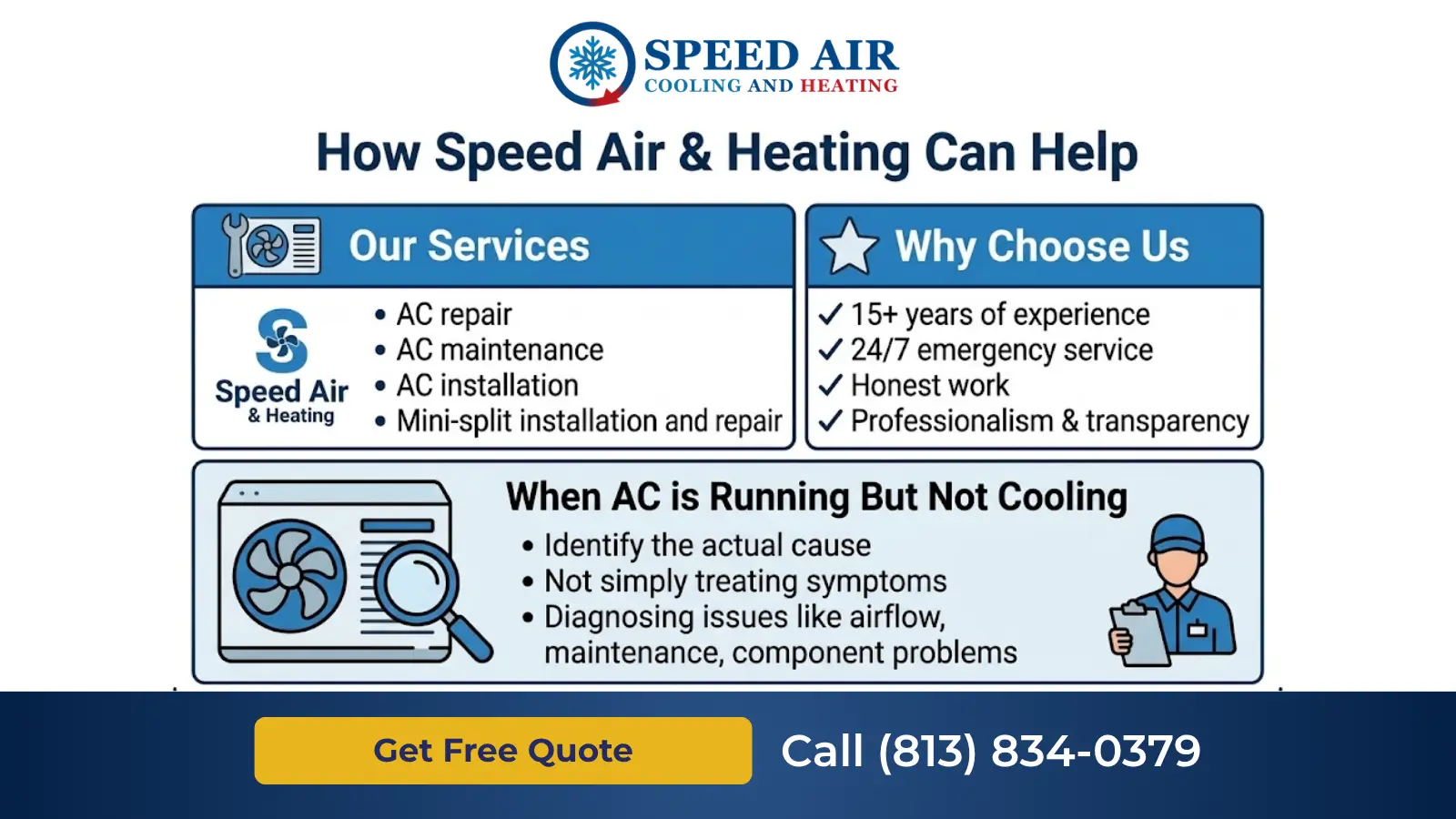
Our services include:
- AC repair
- AC maintenance
- AC installation
- Mini-split installation and repair
Our company information states that we have 15+ years of experience, offer 24/7 emergency service, and focus on honest work, professionalism, transparency, and craftsmanship.
When an AC is running but not cooling, the goal should be to identify the actual cause rather than simply treating the symptom. Whether the issue is airflow, maintenance, a component problem, or something more involved, the appropriate repair depends on what the system is actually doing.
If your AC is running but your Florida home is still not getting cool, contact Speed Air & Heating at (813) 834-0379 to discuss your AC repair needs.
Get a Free Quote!
Call (813) 834- 0379
Frequently Asked Questions
Q: Why is my AC running but not cooling?
A: The most common causes include incorrect thermostat settings, a dirty air filter, a blocked outdoor condenser, frozen evaporator coils, low refrigerant, electrical or mechanical problems, and airflow restrictions. If basic checks do not restore cooling, professional diagnosis can identify the underlying problem.
Q: Why is my AC blowing air but not cold air?
A: The indoor blower can continue moving air even when the cooling process is not working correctly. A dirty filter, frozen coil, low refrigerant, outdoor-unit problem, thermostat issue, or mechanical failure can result in airflow without adequate cooling.
Q: Should I turn off my AC if it is not cooling?
A: If the system is clearly malfunctioning, turning it off while arranging service can help avoid continued operation of a system with a potentially serious problem. This is especially important if you see ice, hear unusual noises, or suspect an electrical or refrigerant issue.
Q: Can a dirty air filter cause an AC to stop cooling?
A: Yes. A heavily clogged filter can restrict airflow, reduce cooling performance, and contribute to evaporator-coil freezing. Replacing a dirty filter is a reasonable first troubleshooting step.
Q: How do I know if my AC is low on refrigerant?
A: Possible signs include long or continuous run times, inadequate cooling, ice on the evaporator coil or refrigerant lines, and higher energy use. However, these symptoms can have multiple causes, so refrigerant levels and potential leaks should be evaluated by a qualified HVAC professional.
Q: Why is my AC running all day?
A: An AC may run for long periods when the cooling demand is high, but continuous operation can also indicate restricted airflow, low refrigerant, dirty coils, equipment problems, or an undersized system. The surrounding symptoms help determine whether the system is operating normally or struggling with a fault.
Q: Why is my AC running but the outside unit is not?
A: If the indoor blower is operating while the outdoor unit is not, possible causes include electrical problems, a failed capacitor or contactor, control problems, or other equipment faults. These components should be evaluated by an HVAC professional rather than opened or tested by a homeowner.
Q: Can I fix an AC that is running but not cooling myself?
A: You can safely start with basic checks such as verifying thermostat settings, replacing a dirty filter, checking vents for obvious obstructions, and clearing obvious debris around the outdoor unit. Refrigerant, electrical, compressor, and internal coil problems generally require professional diagnosis and repair.
Final Thoughts
When your AC is running but not cooling, don’t assume the entire system has failed.
Start with the basics: check the thermostat, inspect the filter, look at the outdoor unit, and pay attention to airflow and signs of ice. If those checks do not solve the problem—or if you notice refrigerant, electrical, or mechanical symptoms—the next step is professional diagnosis.
For Florida homeowners, getting to the underlying cause matters. A system that runs continuously without properly cooling the home is not solving the comfort problem, and continuing to operate a malfunctioning system may add unnecessary strain.
Speed Air & Heating provides AC repair, AC maintenance, AC installation, and mini-split services. For HVAC assistance, contact us today at (813) 834-0379.
Other Services We Offer