
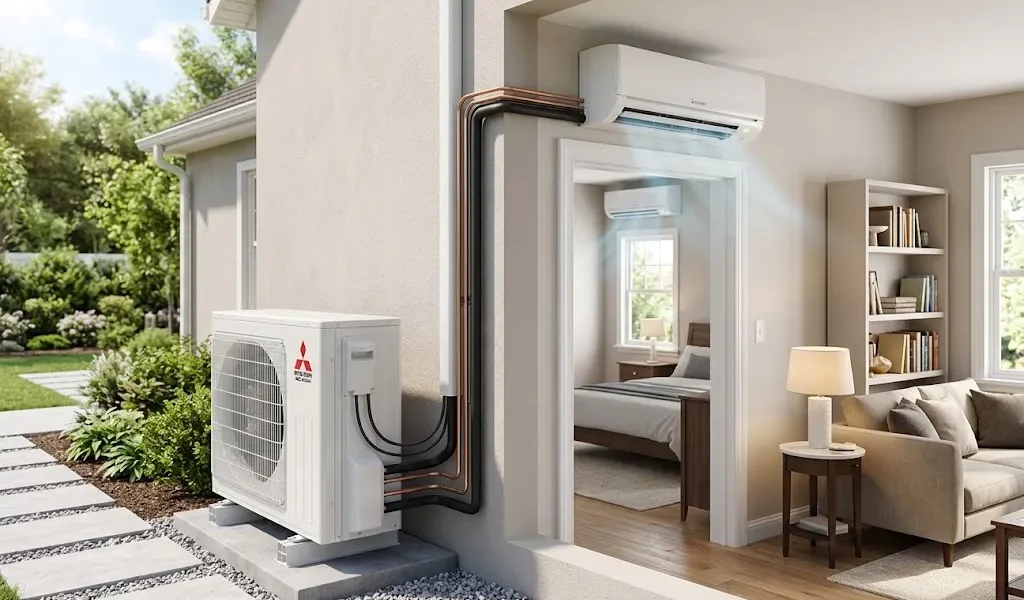
Yes, a mini split can cool multiple rooms—but the system needs to be designed for multiple zones. At Speed Air and Heating, we understand that a single-zone mini split is generally intended to condition one primary space, while a multi-zone mini split connects multiple indoor units to one outdoor unit. Each indoor unit can serve a different room or zone, allowing homeowners to control comfort throughout the home without installing traditional ductwork.
For homeowners in Clearwater, Florida, a multi-zone mini split can be useful when different rooms have different cooling needs, when a home doesn’t have ductwork, or when certain areas consistently stay warmer than others.
Key Takeaways
- Yes, multi-zone mini splits can cool multiple rooms.
- Multiple indoor units connect to a single outdoor unit.
- Each indoor unit can provide temperature control for its own room or zone, depending on the system.
- Proper sizing is important for comfort and system performance.
- Mini splits can be useful for additions, bedrooms, offices, garages, and homes without existing ductwork.
- The number and placement of indoor units should be based on the home’s layout and cooling requirements.
How Can a Mini Split Cool Multiple Rooms?
A multi-zone mini split uses one outdoor unit connected to multiple indoor air-handling units. Each indoor unit is installed in a room or designated zone and receives refrigerant through connecting lines.
Instead of using ductwork to distribute conditioned air throughout the home, the system delivers cooling directly to the spaces where indoor units are installed. ENERGY STAR explains that ductless systems can use one or multiple indoor units, making them suitable for individual rooms as well as larger whole-home applications.
For example, a homeowner could have indoor units serving:
- The living room
- The primary bedroom
- A second bedroom
- A home office
The exact number of indoor units a system can support depends on the equipment selected. Different manufacturers offer different multi-zone configurations.

What’s the Difference Between Single-Zone and Multi-Zone Mini Splits?
The main difference is the number of indoor units connected to the outdoor equipment.
A single-zone mini split has one outdoor unit connected to one indoor unit. It’s commonly used for a bedroom, office, addition, garage, or other individual space.
A multi-zone mini split connects multiple indoor units to a single outdoor unit. This allows several rooms to receive heating and cooling without installing a separate outdoor condenser for every room.
Multi-zone systems can also provide more individualized comfort. Depending on the system, each indoor unit can have its own temperature control, allowing different rooms or zones to be conditioned according to how they’re being used.
Can One Mini Split Cool an Entire House?
It depends on what you mean by “one mini split.”
One indoor unit generally isn’t designed to evenly cool an entire multi-room home. Air from a wall-mounted indoor unit is concentrated in the space where that unit is installed.
However, one multi-zone mini-split system can be designed to cool multiple rooms using several indoor units connected to one outdoor unit.
For larger homes, the system may use multiple indoor units, ducted indoor units, or a combination of approaches. Mitsubishi Electric, for example, notes that whole-home applications can use different indoor-unit configurations depending on the home’s layout and cooling requirements.
The important distinction is that a multi-zone system is one coordinated system—not necessarily one indoor unit.
How Many Rooms Can a Multi-Zone Mini Split Cool?
There’s no universal number that applies to every mini split.
The maximum number of indoor units depends on the specific outdoor unit and system design. Some equipment is designed for two, three, four, or five zones, while other systems support more. Manufacturer specifications should always be checked before selecting equipment.
The home’s cooling load matters just as much as the number of rooms.
A large, sunny bedroom may require a different capacity than a small interior office. Room size, windows, insulation, ceiling height, occupancy, and other factors can affect the amount of cooling required.
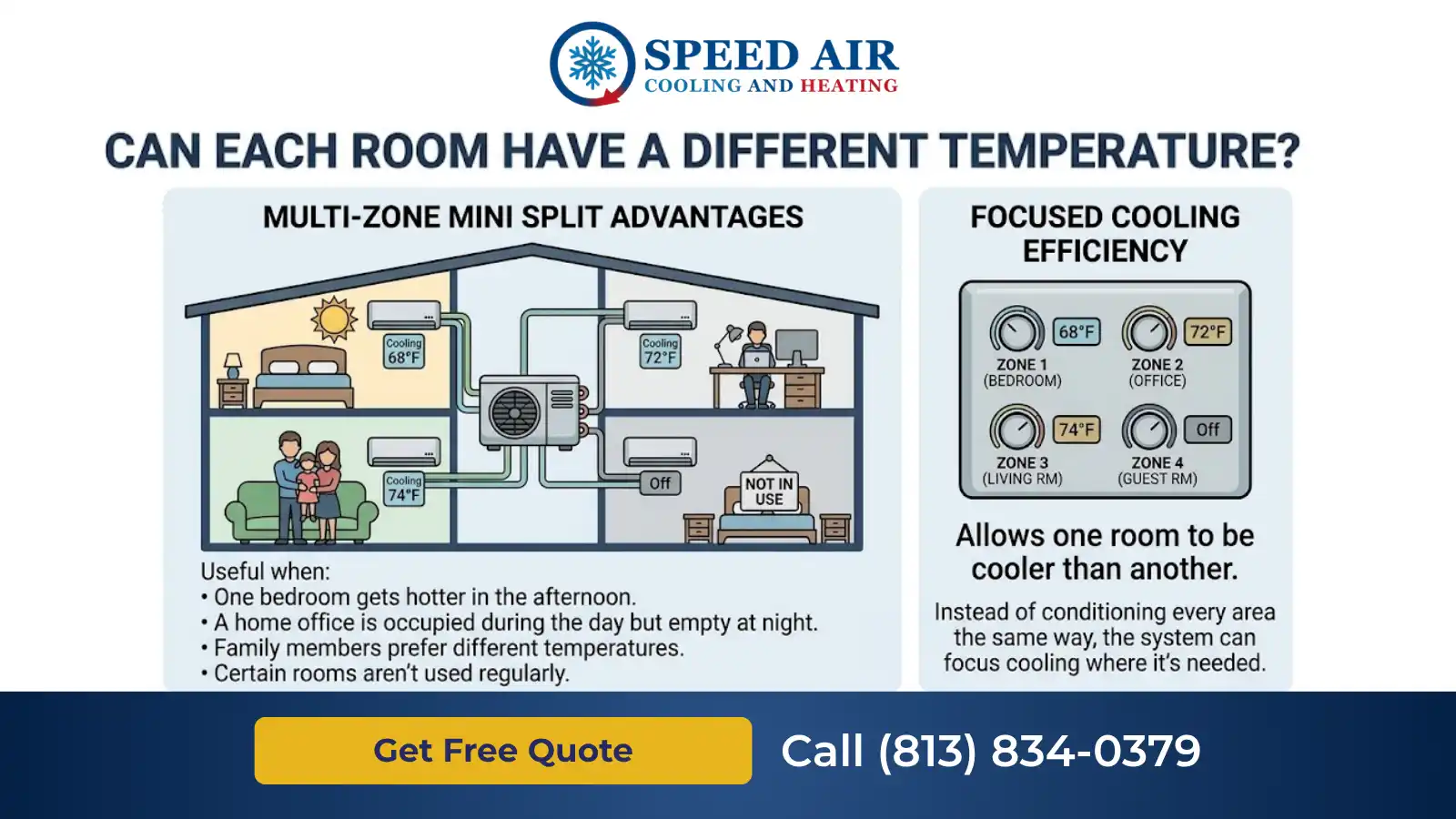
Can Each Room Have a Different Temperature?
With a properly designed multi-zone system, yes.
One of the major advantages of multi-zone mini splits is room-by-room or zone-by-zone temperature control. Different indoor units can be controlled independently, allowing one room to be cooler than another when the equipment supports independent operation.
This can be useful when:
- One bedroom gets hotter in the afternoon.
- A home office is occupied during the day but empty at night.
- Family members prefer different temperatures.
- Certain rooms aren’t used regularly.
- A room has unusually high cooling demand.
Instead of conditioning every area the same way, the system can focus cooling where it’s needed.
Get a Free Quote!
Call (813) 834- 0379
Are Mini Splits Good for Florida Homes?
Mini splits can be a practical option for Florida homes, particularly when extending ductwork isn’t desirable or when certain areas need additional cooling.
They can work well for:
- Older homes without existing ductwork
- Room additions
- Home offices
- Garages and converted spaces
- Bedrooms with uneven temperatures
- Guest rooms
- Areas that are difficult to connect to an existing central HVAC system
ENERGY STAR also identifies additions, outbuildings, older homes without ductwork, and rooms with persistent hot or cold spots as applications where ductless systems can be useful.
Does a Multi-Zone Mini Split Need Ductwork?
No. That’s one of the primary characteristics of a ductless mini split.
Instead of distributing cooled air through a network of ducts, refrigerant lines connect the outdoor equipment to the individual indoor units. This can make mini splits useful for homes where adding ductwork would be difficult or disruptive.
However, “ductless” doesn’t mean installation is simple in every home. Indoor-unit placement, refrigerant-line routing, electrical requirements, drainage, outdoor-unit location, and system sizing all need to be considered.
Why Proper Sizing Matters
Installing multiple indoor units isn’t simply a matter of putting one in every room.
The equipment needs to be sized for the cooling requirements of the spaces being served. ENERGY STAR recommends proper HVAC sizing and notes that equipment that is too large or too small can struggle to provide the desired comfort and performance.
Oversizing or undersizing can affect comfort, operating performance, humidity control, and efficiency.
A professional assessment can help determine which rooms should receive indoor units, what capacity is appropriate, and how the system should be configured.
Is a Multi-Zone Mini Split Better Than Installing Several Separate Units?
That depends on the home.
A multi-zone system can reduce the number of outdoor units needed because several indoor units can connect to one outdoor unit. It also provides a way to create separate comfort zones without installing traditional ductwork.
But the right design depends on the home’s layout, existing HVAC system, electrical setup, available installation locations, and cooling requirements.
In some homes, a combination of central AC and one or more mini splits may make more sense than replacing the entire system with ductless equipment.
Mini Split Installation in Clearwater, Florida
If you’re asking, “Can a mini split cool multiple rooms?”, the answer is yes—when a properly designed multi-zone system is used.
At Speed Air & Heating, we provide mini split installation and repair, AC repair, AC maintenance, and AC installation for Florida homes and businesses.
Our approach focuses on practical system design, clear communication, and dependable HVAC service. If you’re considering a mini split for multiple rooms, the important question isn’t simply how many indoor units can be connected. It’s whether the system is properly sized and configured for your home’s specific cooling needs.

Get a Free Quote!
Call (813) 834- 0379
Final Thoughts
A mini split can absolutely cool multiple rooms when you choose a multi-zone system designed for that purpose. Multiple indoor units can connect to one outdoor unit, providing targeted cooling without traditional ductwork.
The key is proper system design. The number of rooms, room sizes, insulation, windows, layout, and cooling requirements all affect which equipment and configuration make sense.
For Clearwater homeowners considering a multi-zone mini split, a professional evaluation can help determine whether ductless cooling is a good fit and how the system should be configured.
Speed Air & Heating provides AC repair, AC maintenance, AC installation, and mini-split services. For HVAC assistance, contact us today at (813) 834-0379.
Frequently Asked Questions
Q: Can a mini split cool two rooms?
A: Yes. A multi-zone mini split can connect multiple indoor units to one outdoor unit, allowing two rooms to be cooled independently when the system is designed for that configuration.
Q: Can one mini split cool three or four rooms?
A: Yes, if the selected multi-zone equipment supports the required number of indoor units and has sufficient capacity for the spaces being conditioned. Different systems have different zone limits.
Q: Do I need a mini split in every room?
A: Not necessarily. The number and placement of indoor units should depend on the home’s layout, room sizes, cooling loads, and how the spaces are used. Some systems can use different indoor-unit configurations to serve larger areas.
Q: Can a mini split replace central AC?
A: It can in some homes, but not every home is the same. Whole-home mini-split systems can provide heating and cooling through multiple zones, but the appropriate solution depends on the home’s size, layout, existing HVAC system, and cooling requirements.
Q: Are multi-zone mini splits energy efficient?
A: They can be efficient because they allow conditioning to be targeted to individual zones rather than relying on a single temperature setting for the entire home. Actual energy performance depends on equipment efficiency, sizing, installation, settings, weather, and how the system is operated.
Other Services We Offer